

How Washington Farmers and Hunger Relief Orgs Are Working Together
Updated: May 26
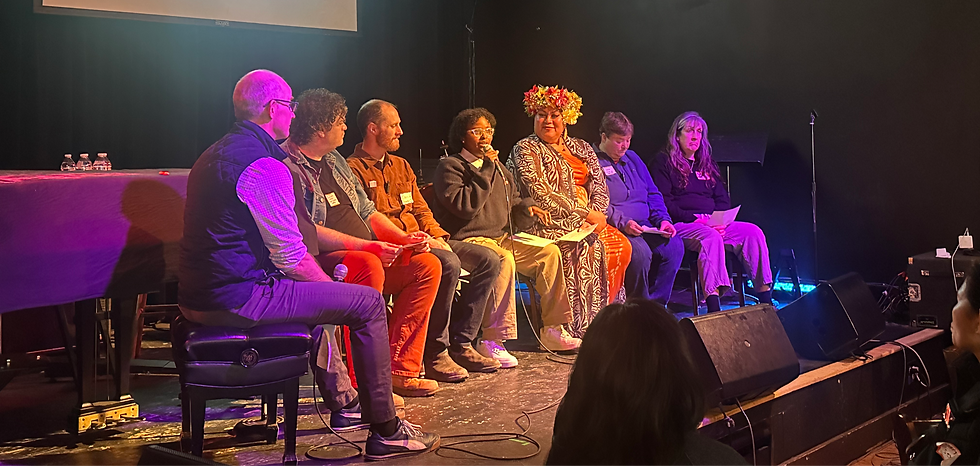
On February 23, 2026, Harvest Against Hunger (HAH) hosted the third annual Grower Roundtable in collaboration with Growing for Good (GFG). This year's event was generously hosted by Royal Room in Columbia City, with 38 hunger relief staff and 20 farmers in attendance.
The conference-style gathering brought together farmers, hunger relief staff, and food systems professionals primarily from two of HAH's Farm to Community programs, King County Farmers Share and GFG. Insights from the Roundtable inform future Farm to Community program development and provide an opportunity for farms and hunger relief organizations (HROs) to connect prior to the growing season.
King County Local Food Initiative Presentation
To start the day, King County Local Food Economy Manager Mike Lufkin gave an overview of the King County Local Food Initiative (LFI) and its 2025 refresh. This updated plan was built over 18 months through a community-driven process involving surveys, listening sessions, interviews, focus groups, and an advisory council. The 10-year roadmap has two main focuses: growing the local food and farm economy and
expanding access to healthy, affordable food for all residents. The update was designed to address pressing challenges in our current food system, such as rising food insecurity, land prices, climate change, policy shifts, and more.
The LFI includes 4 Goal Areas:
Equitable Food Access
Thriving Local Food Economy
Farmland Protection & Sustainable Production
Environmental Sustainability & Climate Resilience
Mike walked through each Goal Area, highlighting its Objectives and Actions that support farmers and farm to community work. Some examples included accelerating farmland preservation, lowering administrative and regulatory barriers, increasing values-based purchasing among buyers, incentivizing the adoption of climate-smart food production practices, and many more. The presentation closed with a Q&A with audience members.
Flood Relief Presentation
Following this, Jennifer Antos of Seattle Neighborhood Farmers Markets offered recovery resources in light of the atmospheric river flooding that devastated farmland across Western Washington in late 2025. She shared an overview of flood relief grant opportunities offered by organizations across Washington, including WA Farmland Trust, Seattle Neighborhood Farmers Markets, Tilth Alliance, NW Agricultural Business Center, and Snoqualmie Valley Preservation Alliance. Jennifer walked through the variations in eligibility and application advice. She also offered handouts in English and Spanish for attendees to take home.
Mariah closed the presentation by introducing Eat Local First, a collaborative initiative that offers a single directory and resource for farms and food businesses across the state. The website includes a page that outlines flood relief resources introduced by Jennifer, as well as donation opportunities. Eat Local First also added a flood-impact indicator to its consumer tool, allowing farms to increase visibility and receive direct support from the community. Mariah encouraged farms to use this resource and offered technical assistance with creating listings.
Farm & Hunger Relief Panel Discussion
Lastly, David Bobanick, executive director of HAH, moderated a discussion panel with three sets of farmer/HRO staff partners to learn from their unique partnerships.
Kris Van Gasken (Des Moines Area Food Bank) & Claudia Frey (Frey Family Farms)
Kris and Claudia discussed their longstanding partnership and how it’s evolved beyond transactions. Kris shared that investing in strong relationships with farmers has enabled her to request specific, culturally relevant items for the food bank. She also supports producers with technical assistance, such as helping Claudia with grant writing and navigating funding opportunities.
Claudia described how her understanding of the hunger relief funding landscape has deepened over time, motivating her to engage more actively in advocacy for farm purchasing programs. Both emphasized that consistent, transparent communication is the foundation of their collaboration. Their partnership highlights how mutual investment between farmers and food banks can strengthen both economic resilience and community health.
Toni Tufupia (UTOPIA WA) & Hoda Abdullahi (Living Well Kent)
Toni and Hoda discussed the creative ways their organizations have supported each other over the years. Hoda framed funding systems as “pressure valves,” noting that while the food system is full of innovative and dedicated leaders, many lack access to the resources needed to fully realize their work. Hoda prioritizes sharing Living Well Kent’s resources, aiming to keep resource valves open for others.
Toni described how their partnership began not with direct funding but with shared resources like garden beds and farming expertise. This relationship grew into a unique collaboration that allows UTOPIA WA to cultivate culturally relevant crops for their community. Toni described how this food connects people to their heritage while sustaining dignity, health, and cultural traditions.
Jason Austin (Meals Partnership Coalition) & Chris Teeny (Farmstand Local Foods)
Jason first introduced the Meals Partnership Coalition, which coordinates funding and food procurement to support meal programs across the region. By aggregating resources, MPC is able to provide reliable purchasing for partners with specific ingredient and timing needs.
Chris, co-owner of Farmstand Local, spoke about his role in bridging the gap between farmers and diverse markets, including restaurants, consumers, and hunger relief organizations. In addition to distribution, Farmstand Local supports partners like MPC with purchasing logistics and grant reporting. Both Chris and Jason emphasized the importance of stable, multi-year funding. This offers opportunities for improved crop planning, operational familiarity, and trust.
Roundtable Discussions
Before closing the event, the room broke into small groups for a roundtable discussion. Groups were asked about strategies for strengthening Farm to Community efforts locally and for building their own partnerships. A representative from each group then shared key points from these conversations with the room. These takeaways coalesced into 7 main topics:
Multi-Year Funding & Long-Term Stability: The single most cited need was for longer funding cycles and multi-year contracts. Short, 1-year funding horizons make it challenging for farmers to plan crops, build relationships, and
grow sustainably.
Land Access & Farmer Viability: Structural barriers to farming (land access, lease terms, resource costs) were cited as foundational challenges.
Cultural Relevance & Language Access: Multiple participants emphasized the need for culturally appropriate foods and language access, framing these not as extras but as equity issues.
Relationship Building & Trust: Trust between farmers, HROs, and funders was repeatedly described as essential, but slow-building and easily disrupted by program instability.
Dignity & Autonomy in Food Access: The concept of dignity, both for farmers and for food recipients, came up across multiple conversations and was frequently described as the core of this work.
Grant Writing & Technical Assistance: Across nearly every conversation, participants identified grant writing and administrative burden as a major barrier for farmers, creating an opportunity external support.
Policy Advocacy & Government Investment: Multiple participants called for deeper, more coordinated engagement with county and state policy.
Farm to Community Grower Roundtable Wrap-up
The Farm to Community Grower Roundtable closed with a social hour for attendees to continue the conversation. All farmers attending the event were offered $120 travel stipends, using King Conservation District funds, recognizing the value of their time.
The experiences and insights shared by our Roundtable participants are invaluable in shaping the future of Farm to Community across the state. We appreciate the time,
presence, and perspectives of everyone who joined us.
Thank you to King Conservation District, PCC Community Markets, Seattle Neighborhood Farmers Markets, and the Royal Room for helping make the 2026 Food Systems Roundtable possible.
To learn more, check out the full report below: